On February 19th the International Whale’s Day has been marked since the International Whaling Commission proclaimed a ban on whaling in 1986. For many decades of the 20 th century whale fishers have been hunting these marine giants for meat, whale bones, whale blubbers or bone flour. Eventually,the number of whale individuals significantly declined and many species found themselves on the verge of extinction. As an example, blue whales might be provided. Recent estimations of their population cannot find a common dominator; some claim that there up to 2 thousand blue whales in the World Ocean, others point out 15 thousand whales distributed over Northern and Southern hemispheres. In particular, blue whales are considered the crown jewel of the Atlantic Ocean, especially northern areas.
Blue whales are recognized as the biggest mammals on the Earth. The average weight is nearly 100-120 tones, which corresponds to a value of 40 African elephants. To support normal living a whale should consume 1 million calories per day that is usually comprised of krill (1 tone). Speaking of meal culture, it is impossible not to mention its peaceful nature, as far as blue whales are typical planktotrophics, which makes the situation with their extinction more sorrowful and distressing.
The other peculiar feature worth underlining is a specific way of communication between individuals. It is associated with whale songs, which are recognized by individuals on the distance of 1600 km. They are often observed during reproduction period, underlining the connection to family functions of mammals. This fact has alerted an attention of scientists and zoologists, dealing with gathering some facts about blue whales.
To be more précised, scientific interest is one out of two issues, which allow whales’ hunting. The other one is necessities of indigenous people in whale hunting. As a source of food it is not forbidden for the indigenous peoples of Alaska, the Far Eastern regions of Russia and Greenland, Saint Vincent and the Grenadines. Meat was the prime purpose of animals’ population decline; in particular, an adult blue whale individual can give about 40 tons of meat. The statistics concludes that during the 20 the century the number of whales decreased in 100 times.
However, hunting is not the only reason of blue whales disappearance. In this context, clashes with seacrafts are getting more and more serious. The average number of whale deaths from marine vessels is 1,2 accidents per year, but there are also true record years; for example, in 2007 4 fatal encounters occurred in the Pacific Ocean. Gulf of Saint Lawrence is also a region, where blue whales get lots of
injuries. According to marine observations the number of whales suffering from scars and wounds reaches 9-25%. The other negative effect sea vessels perform is a disturbance of echolocation abilities of whales. Voice signals are often silenced, which makes the communication and shoals’ formation almost impossible. It also influences on blue whales’ number within waters of the World Ocean.
Guest Post by Maria Kruk, an author for Species.com
Showing posts with label Marine Creatures. Show all posts
Showing posts with label Marine Creatures. Show all posts
Monday, July 30, 2012

Tuesday, September 28, 2010
Defiance In Japan -- serious dolphin hunts at Taiji
Sadly, even after repeated campaigns related to anti-cruelty to animals, country like Japan still seems to be staying quite aloof and carrying out their own inhuman acts of animal cruelty. The Japanese government is defiant and has allowed the first dolphin kill of this season at Taiji. A school of 15 Risso's dolphins had been chopped brutally and transferred to the slaughterhouse.
RIC O'BARRY, on behalf of “EARTH ISLAND INSTITUTE INC” in his message said, “I can't tell you how angry this makes me. And I know it makes you angry, too. Many of you will be frustrated, but I don’t want you to lose hope. I am more convinced than ever that our campaign to generate worldwide pressure for an end to the slaughter is right and must succeed. We must be vigilant and turn up the heat. The Japanese government's defiance must not be allowed to stand. Change does not happen overnight, and we have only just started to get the word out to the Japanese people.” He also said, “we are working to keep people on the ground in Taiji to monitor the Cove and report back to the world.”
This video was done by one of the dedicated volunteers, Leilani Münter:
According to the officials at the EARTH ISLAND INSTITUTE INC are ramping up efforts with their distributor at Japan to get thousands of copies of the Japanese version of “THE COVE” into the hands of general mass at Japan. The situation is seriously grave and can be solved only by the Japanese people themselves. They can only put an end to such cruelty to animals.
A volunteer in Tokyo had interviewed several Japanese regarding “THE COVE” and the dolphin slaughter. According to her all of them had already heard about the mass killing of dolphins at Taiji, and there had been a noticeable change in thoughts from several months ago when nobody was aware of the issue of dolphin hunts.
Good news is the US President Barack Obama is flying off to Japan in November, 2010 in order to urge quick attention to this matter. Thank you and all the best Mr. Barack Obama.
Our keen request to Japanese government... Please stop these types of sports, educate yourselves and be responsible towards nature.
RIC O'BARRY, on behalf of “EARTH ISLAND INSTITUTE INC” in his message said, “I can't tell you how angry this makes me. And I know it makes you angry, too. Many of you will be frustrated, but I don’t want you to lose hope. I am more convinced than ever that our campaign to generate worldwide pressure for an end to the slaughter is right and must succeed. We must be vigilant and turn up the heat. The Japanese government's defiance must not be allowed to stand. Change does not happen overnight, and we have only just started to get the word out to the Japanese people.” He also said, “we are working to keep people on the ground in Taiji to monitor the Cove and report back to the world.”
This video was done by one of the dedicated volunteers, Leilani Münter:
According to the officials at the EARTH ISLAND INSTITUTE INC are ramping up efforts with their distributor at Japan to get thousands of copies of the Japanese version of “THE COVE” into the hands of general mass at Japan. The situation is seriously grave and can be solved only by the Japanese people themselves. They can only put an end to such cruelty to animals.
A volunteer in Tokyo had interviewed several Japanese regarding “THE COVE” and the dolphin slaughter. According to her all of them had already heard about the mass killing of dolphins at Taiji, and there had been a noticeable change in thoughts from several months ago when nobody was aware of the issue of dolphin hunts.
Good news is the US President Barack Obama is flying off to Japan in November, 2010 in order to urge quick attention to this matter. Thank you and all the best Mr. Barack Obama.
Our keen request to Japanese government... Please stop these types of sports, educate yourselves and be responsible towards nature.

Thursday, August 27, 2009
Prematured Death of Basking Shark
Giant Basking Shark Had Washed Ashore on 14 August, 2009
Very recently on Tuesday July 14, 2009 a male basking shark was found dead on the Long Island beach. This 26 feet, 6 inches long majestic creature was incredibly heavy with around 5000 pounds body weight. The marine educator Tracy Marcus of the Cornell Cooperative Extension informed that the male basking shark died shortly after the had authorities arrived on the scene. According to Tracy Marcus, there wasn't any abrasion found in the external part of the shark's body. What could be the possible reason of the premature death of the basking shark? Marcus said that the shark might be struck by a heavy vessel or boat, but that was merely an assumption. The reason of the sudden death of the shark is still not known. Confusion also surged in to people's mind as to what actually made the shark find its way to the Gilgo State Park near Babylon in Suffolk County. According to David Chapman of Stony Brook University, "It didn't die of old age, because they get to 35 or 40 feet." The shark was around 26 feet long, which indicates that the death is premature. Yet still, it was an imposing site to those who were present on the beach when the shark actually washed up the shore.
 The British conservationists have petitioned to have the majestic creature "hotspots" protected. Researchers have spared adequate thoughts over the issue. They think that the summer temperature might be responsible for an explosion the population of the zooplankton off the coasts of Britain and Ireland. This made many basking sharks attracted to the specific region. While during the last year (2008) there were only 26 basking sharks sighted, but the since the beginning of June, 2009 the total sightings have been recorded to be more than 900; June's record alone have shown an incredible number of sightings of 248 basking sharks!
 A Marine and Coastal Access Bill has made its way through British Parliament with a noble motive to introduce "marine conservation zones". The "marine conservation zones" is a protected area in the ocean to be identified basking shark "hotspots".There will be speed limitations for the boats in this area. 47 wildlife trusts across the UK, Alderney, and the Isle of Man are heading the project. Lissa Goodwin the marine policy officer of these trusts said that the chief aim of the group "is to ensure there is no loss in the population size" of basking sharks.
Very recently on Tuesday July 14, 2009 a male basking shark was found dead on the Long Island beach. This 26 feet, 6 inches long majestic creature was incredibly heavy with around 5000 pounds body weight. The marine educator Tracy Marcus of the Cornell Cooperative Extension informed that the male basking shark died shortly after the had authorities arrived on the scene. According to Tracy Marcus, there wasn't any abrasion found in the external part of the shark's body. What could be the possible reason of the premature death of the basking shark? Marcus said that the shark might be struck by a heavy vessel or boat, but that was merely an assumption. The reason of the sudden death of the shark is still not known. Confusion also surged in to people's mind as to what actually made the shark find its way to the Gilgo State Park near Babylon in Suffolk County. According to David Chapman of Stony Brook University, "It didn't die of old age, because they get to 35 or 40 feet." The shark was around 26 feet long, which indicates that the death is premature. Yet still, it was an imposing site to those who were present on the beach when the shark actually washed up the shore.
 The British conservationists have petitioned to have the majestic creature "hotspots" protected. Researchers have spared adequate thoughts over the issue. They think that the summer temperature might be responsible for an explosion the population of the zooplankton off the coasts of Britain and Ireland. This made many basking sharks attracted to the specific region. While during the last year (2008) there were only 26 basking sharks sighted, but the since the beginning of June, 2009 the total sightings have been recorded to be more than 900; June's record alone have shown an incredible number of sightings of 248 basking sharks!
 A Marine and Coastal Access Bill has made its way through British Parliament with a noble motive to introduce "marine conservation zones". The "marine conservation zones" is a protected area in the ocean to be identified basking shark "hotspots".There will be speed limitations for the boats in this area. 47 wildlife trusts across the UK, Alderney, and the Isle of Man are heading the project. Lissa Goodwin the marine policy officer of these trusts said that the chief aim of the group "is to ensure there is no loss in the population size" of basking sharks.
Tuesday, July 14, 2009
Blue Groper - The Mysterious Fish That Can Change its Sex
 Fish Mystery – Blue Groper, The Mysterious Fish
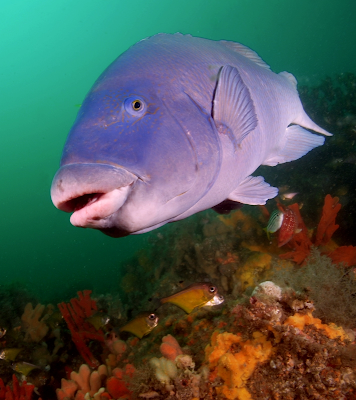
Professional divers in Australia have always loved watching Blue Gropers, an amazing fish that is known for it’s ability to change its sex. Interestingly this natural ability has been seldom found in the animal kingdom on the Earth. Blue Gropers that grow around three feet long and has the natural ability to get transgendered by themselves has been reported to be facing the threat of extinction. This piece is all about the the fish mystery and this mysterious fish that can change its sex.
The Blue Groper, commonly called Bluey is one of the ocean-living icons of Australian state of New South Wales. Not only their mysterious, natural ability of changing their own sex, but also their friendly nature have made these fishes one of the faves of Australian divers. SOUNDBITE (English), Bob Harcourt, Associate Professor Macquarie University said, "the blue groper is a large fish, but the really sexy thing about Blue Groper is they start off as females. We've got lots of blue groper that are small green groper and as an old male dies then the largest most dominant females turns blue and becomes male. And so one of the really cool things about these fish, is the sex ratio doesn't really vary, but it is a function of how well protected they are. If you take a lot of males out, then the females have to spend a lot of their time turning into males, which means they can't breed and they can't lay eggs." SOUNDBITE (English), Kate Lee, Researcher said, "how much time they spend in the different zones. Obviously we've come along and put down these are boundaries and put it on as a human boundary but animals don't listen to the boundaries we put. So we are looking at how much movement there is between the fished zones and the un-fished zones and if there spending a lot of time moving between the two, then obviously the reserve is going to be less effective than if they were staying in those particular zones."
Very little is actually known about the sex changing factor(s) in these fishes. What the researchers have been able to discover is that after reaching a certain age and size the female Blueys automatically get transgendered.
Interesting Facts About Mysterious Fish – Blue Groper
- Quite interestingly, although they are called Blue Groper, this mysterious fish is anot actually a Groper. Blueys actually falls in the Wrasses family.
- Blue Gropers are usually found on exposed reefs at around 0 – 40 meters depth of water. These mysterious fishes actually range between Wilsons Promontory in Victoria up the east coast to the Hervey Bay Queensland.
- Blue Groper starts off with small green color as juvenile and grows into broen or reddish. But as soon as an old male dies out, the largest and the dominant females gradually turns into blue and mysteriously becomes a big male fish.
- No Blue Gropper starts its life as a male… they always starts their life as females.
- Researchers believe that if the female population of Blueys gets increased, a female gets transgendered in to males if the male to female ratio is exceeded.
- Bluey males are quite aggressive to each other and usually one male is notice in a small school of Blue Groper females.
- Blue Groper has been reported to have an incredibly long life span of 35 years. A 10 year old Bluey can grow approximately 48cm long and can weigh around 2.4 kgs. On reaching 20 years of age a Blue Groper becomes approximately 62cm long and can weigh around 5.3 kgs and on reaching 30 years of age the Blue Gropers becomes approximately 73cm long and weighs around 8.4 kgs.
- In the year 1998, the Eastern blue groper was officially made the state fish emblem of New South Wales.
Saturday, May 16, 2009
Blue-Spotted Grouper – Perfect Marine Fish for Your Dream Marine Aquarium
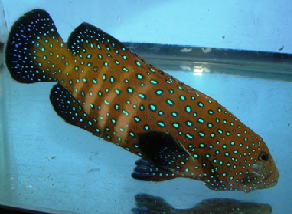 Hey, if you are planning to set up your dream marine tank… a gorgeous, large one, I have a fish for you! If you have a tank already, and facing certain odds that go with it, you might want to change the set up and the fishes. I’ll be talking about a beautiful fish - Blue Dot Grouper that you can try out. If you are thinking that you might be at a loss as to how to stock it, believe me it’s not a rocket science! With its real knockout glamor the Blue Dot Grouper will definitely fill the bill! The most common dilemma that most of the not-so-expert aquarists usually face regarding stocking Blue Dot Grouper is the size of tank! Remember, Blue Dot Grouper is really a large variety of fish and requires a large tank – minimum 100 gallon.
Also called Blue-spotted Grouper, Argus Grouper, Peacock Rockcod , Peacock Sea Bass or Peacock Hind, this beautiful marine aquarium fish is of Indo-Pacific and Hawaii origin and amongst the sturdy ornamental fishes that have earned a great deal of admiration by aquarists world wide. Being a sea bass from the family Serranidae, the Blue Dot Grouper primarily feeds on other small fishes in the wild, though it can be fed on crustaceans (krill, small fish, shrimp, mussels etc.) too in your aquarium. Feed at least two times a day with its preferred meaty food items. Remember, this most attractive member of the genus is a bit too aggressive by nature and its compatibility must be give careful consideration. Only one Blue Dot Grouper fish should be kept in a tank. Although this beautiful marine fish may appear a bit shy while introducing, it will soon prove to be one of the most beautiful, smart, disease resistant and personable member of your marine aquarium.
One of the most interesting facts about this wonderful marine fish is that it can change its body color to match with its surroundings. In its natural habitat, Blue Dot Grouper fish is usually seen around the coral reefs. Blue Dot Grouper fish has six white vertical stripes or bands, running along the length from the pectoral fin till the tail fin, adding spice to its beauty. Interestingly these white bands sometimes becomes prominent, while sometimes get faded off being contingent upon the fish’s surrounding environment and its reaction towards it. When threatened these vertical white bands seems to be faded off.
Blue Dot Grouper – Fast Facts
- Scientific names: Cephalopholis argus
- Origin: Indo-Pacific region.
- Taxonomy: Blue Dot Grouper fish belongs to the Kingdom Animalia, Phylum Chordata, Class Actinopterygii, Order Perciformes, Family Serranidae, Genus Cephalopholis and Species argus
- Fish Size: Approximately 16 inches on maturity.
- Tank Size: Minimum 100 gallon fish-only tank with ample space to move freely
- Color: Blue, Brown, Tan and Green colors with vibrant blue spots. The fins are dark Blue in color with its lighter, yet prominent shade outlining the fins.

- Aggression: Generally aggressive towards the other marine aquarium invertebrates in captivity.
- Compatibility: Blue Dot Grouper fish is moderately reef compatible. This aggressive marine fish can be kept with other aggressive and semi-aggressive tank mates like, Lionfish, Angelfish, Scorpion Fish, Marine Eels, Surgeons and Tangs.
- Light: Blue Dot Grouper appreciates moderately low illumination in the marine aquarium.
- Temperature of water: Water temperature should range between 72 to 78 degrees Fahrenheit.
- Specific gravity of water: 1.023 to 1.025.
- pH of water: 8.10 to 8.40.
• Blue Dot Grouper is a large fishes and develops habit to dislodge the corals in your marine aquarium. It is hence advisable not to keep it in a Reef Type Marine Aquarium.
• Due to its large size and voluminous eater, Blue Dot Grouper usually leaves around lot of waste in the marine aquarium. You should be highly vigilant to keep your tank’s water perfectly clean by using very effective biological filter.
Saturday, May 9, 2009
Keeping Piranha Fishes in Your Aqurium
 If you are given a chance to take a refreshing dip into the cool Amazon basin to beat the summer heat, I am sure you will want to enjoy it to the fullest, unless you do not have to play the role of a chewing toy for a school of Piranha. The infamous piranha fish has a good deal of reputation of nibbling live or dead animals. Though this might sound a bit too awkward, but the fact is that a school Piranha can strip flesh off a full sized cow in just a few minutes. Truth be told… Piranha prefers to scavenge on dead animals, and if there's not an option like that, they'll surely move on to tales and scales of other mates in the vicinity.
My personal experience with just one Piranha in my tank had really been bad… probably the worst one, I could ever share! I had a medium-large tank, where I intended to keep a Piranha along with the other aggressive tank mates of Chiclids family, including two Tiger Oscars, one Red Oscar, two Albino Oscars and one gray-black spotted Plecostomus cat fish of around 6” - 7” long… none of them were full grown. I had to shift my Red Scatophagus argus and Green Argus to a separate salty tank. I still remember, it was Monday evening sometimes around mid Autumn, when I brought my long desired Piranha and released it with the Oscars. Let me hide and seek… I wasn’t really aware of the fact that Prinaha could eat up the world, until (the next morning) I found two of my Oscars head without the body and one of the Albinos was still live with its tail nibbled off! Strangely it did not harm my cat fish, which proved that Piranhas can be kept with Plecostomus cat fishes. The Piranha wasn’t a full grown one, but obviously a bit older than all of its other tank mates. I started digging more into the world of Piranha; never kept another, but collected some really researched information from varied sources, a bit of which, I thought, you guys would like to read about.
The piranha is a member of Characidae ( also called Characin) family. Characin is a large family of over around 1200 species of aggressive fishes, of which some have earned a great deal of admiration as very popular aquarium fishes, like all the common discuss and butterfly fishes. Although importing and trading Piranha is illegal in many states in the US, including the state of California, the law is not that stringent in other parts of the world. They are easily traded in many parts of the world. Amongst many varieties of Piranha fishes, the Red Belly Piranha (Pygocentrus Ntereri) is the most common as aquarium fishes. Reports of Piranhas nibbling people in their habitat to dead, has hardly been heard, but it will definitely bite your finger hard if you dip it in a tank of Piranhas. That happens probably because they turn out to be more aggressive in captivity.
Many of my peeps ask me if Piranhas can be kept with other fishes. Yes, but not with all kind of fishes, as the case holds good for many aggressive and semi-aggressive communal fishes too! I will recommend Piranhas with Plecostomus cat fishes, provided they (cat fishes) are not too small in size. Better not to release new Plecostomus cats in the tank full of Piranhas; rather you can release new Piranhas with already existing cats. You can keep Piranhas safely with large sized Green Spot Texas Cichlids, Wimple Piranha (which is not actually a true Piranha), large Red Belly Pacu and Black Pacu etc. Better to keep at least three Piranhas in a tank. Pacu mingles well Piranhas and thrive along well.
Subscribe to:
Posts (Atom)



 Posts
Posts