India is the world's fourth nation that banned catching and importing cetaceans for commercial entertainment. Other countries are Costa Rica, Hungary and Chile. India Government has been influenced by the outcome of the research on dolphins that established that these creature are highly intelligent and very sensitive. The government has taken a decision to close all dolphin parks in India.
Puja Mitra from the Federation of Indian Animal Protection Organizations (FIAPO) in this context said, "the scientific evidence we provided during the campaign talked about cetacean intelligence and introduced the concept of non-human persons," she added, "the majority of dolphins and whales in captivity have been sourced through wild captures in Japan, in Taiji, in the Caribbean, in the Solomon Islands and parts of Russia. These captures are very violent"
It is really a great news that India's Government has given dolphins a status of “non-human personhood”, making the country unique in the way the people there thinks about the endangered species like dolphins. The decision of granting dolphins the status of “non-human personhood” was officially announced by India’s Minister of the Environment and Forests. The government outlawed captive dolphin shows and the ministry said that dolphins “should have their own specific rights.”
Showing posts with label Endangered Species. Show all posts
Sunday, September 8, 2013
Monday, June 3, 2013
Initiative to save Indian Elephants - London
London, Monday, May 27:
Two life-size Indian elephants statues have been installed in Sloane Street, London to flag the launch of the awareness program and the initiative to save India elephants. A charity - 'Elephant Family' founded by Mark Shand, the well known travel writer and conservationist collaborated with another London charity Habitat Humanity for the Animal Ark programme with a noble motive to raise funds that would be used to save Indian elephants.
Shand said that "the two beautiful floral elephants" in the Sloane Street of London indicated the huge "Animal Ark" that they are going to build the coming year - 2014. As a part of the Animal Ark program they will bring in 100 pairs of distinctive species of animals and each of them will be auctioned to raise the funds for protecting the endangered Asian elephants.
"We have cleared the Nilgiri corridor and are now moving to a smaller corridor in Assam. In India, a person kills an elephant and vice versa every single day now as the traditional migratory routes are blocked leading to conflict... Our project with Habitat for Humanity involves building homes for people to clear these corridors. It is a win-win situation for everybody...", said Shand. Over 2013 and 2014, the activities of Elephant Family and Habitat for Humanity include raising awareness about Indian elephants and helping communities to resettle beyond the danger area. Most interestingly the program also includes restoring the paths that have been in use by the Asian elephants for migration for millions of years.
One of the sponsors of the initiative Viscount Chelsea, chair of Cadogan Estates Limited said, "to see these life-size elephants decked out with flowers by (florists) Wild At Heart on an iconic fashion street of London like Sloane Street is a first".
Two life-size Indian elephants statues have been installed in Sloane Street, London to flag the launch of the awareness program and the initiative to save India elephants. A charity - 'Elephant Family' founded by Mark Shand, the well known travel writer and conservationist collaborated with another London charity Habitat Humanity for the Animal Ark programme with a noble motive to raise funds that would be used to save Indian elephants.
Shand said that "the two beautiful floral elephants" in the Sloane Street of London indicated the huge "Animal Ark" that they are going to build the coming year - 2014. As a part of the Animal Ark program they will bring in 100 pairs of distinctive species of animals and each of them will be auctioned to raise the funds for protecting the endangered Asian elephants.
"We have cleared the Nilgiri corridor and are now moving to a smaller corridor in Assam. In India, a person kills an elephant and vice versa every single day now as the traditional migratory routes are blocked leading to conflict... Our project with Habitat for Humanity involves building homes for people to clear these corridors. It is a win-win situation for everybody...", said Shand. Over 2013 and 2014, the activities of Elephant Family and Habitat for Humanity include raising awareness about Indian elephants and helping communities to resettle beyond the danger area. Most interestingly the program also includes restoring the paths that have been in use by the Asian elephants for migration for millions of years.
One of the sponsors of the initiative Viscount Chelsea, chair of Cadogan Estates Limited said, "to see these life-size elephants decked out with flowers by (florists) Wild At Heart on an iconic fashion street of London like Sloane Street is a first".
Monday, July 30, 2012
International Whale’s Day - February 19th
On February 19th the International Whale’s Day has been marked since the International Whaling Commission proclaimed a ban on whaling in 1986. For many decades of the 20 th century whale fishers have been hunting these marine giants for meat, whale bones, whale blubbers or bone flour. Eventually,the number of whale individuals significantly declined and many species found themselves on the verge of extinction. As an example, blue whales might be provided. Recent estimations of their population cannot find a common dominator; some claim that there up to 2 thousand blue whales in the World Ocean, others point out 15 thousand whales distributed over Northern and Southern hemispheres. In particular, blue whales are considered the crown jewel of the Atlantic Ocean, especially northern areas.
Blue whales are recognized as the biggest mammals on the Earth. The average weight is nearly 100-120 tones, which corresponds to a value of 40 African elephants. To support normal living a whale should consume 1 million calories per day that is usually comprised of krill (1 tone). Speaking of meal culture, it is impossible not to mention its peaceful nature, as far as blue whales are typical planktotrophics, which makes the situation with their extinction more sorrowful and distressing.
The other peculiar feature worth underlining is a specific way of communication between individuals. It is associated with whale songs, which are recognized by individuals on the distance of 1600 km. They are often observed during reproduction period, underlining the connection to family functions of mammals. This fact has alerted an attention of scientists and zoologists, dealing with gathering some facts about blue whales.
To be more prĂ©cised, scientific interest is one out of two issues, which allow whales’ hunting. The other one is necessities of indigenous people in whale hunting. As a source of food it is not forbidden for the indigenous peoples of Alaska, the Far Eastern regions of Russia and Greenland, Saint Vincent and the Grenadines. Meat was the prime purpose of animals’ population decline; in particular, an adult blue whale individual can give about 40 tons of meat. The statistics concludes that during the 20 the century the number of whales decreased in 100 times.
However, hunting is not the only reason of blue whales disappearance. In this context, clashes with seacrafts are getting more and more serious. The average number of whale deaths from marine vessels is 1,2 accidents per year, but there are also true record years; for example, in 2007 4 fatal encounters occurred in the Pacific Ocean. Gulf of Saint Lawrence is also a region, where blue whales get lots of
injuries. According to marine observations the number of whales suffering from scars and wounds reaches 9-25%. The other negative effect sea vessels perform is a disturbance of echolocation abilities of whales. Voice signals are often silenced, which makes the communication and shoals’ formation almost impossible. It also influences on blue whales’ number within waters of the World Ocean.
Guest Post by Maria Kruk, an author for Species.com
Blue whales are recognized as the biggest mammals on the Earth. The average weight is nearly 100-120 tones, which corresponds to a value of 40 African elephants. To support normal living a whale should consume 1 million calories per day that is usually comprised of krill (1 tone). Speaking of meal culture, it is impossible not to mention its peaceful nature, as far as blue whales are typical planktotrophics, which makes the situation with their extinction more sorrowful and distressing.
The other peculiar feature worth underlining is a specific way of communication between individuals. It is associated with whale songs, which are recognized by individuals on the distance of 1600 km. They are often observed during reproduction period, underlining the connection to family functions of mammals. This fact has alerted an attention of scientists and zoologists, dealing with gathering some facts about blue whales.
To be more prĂ©cised, scientific interest is one out of two issues, which allow whales’ hunting. The other one is necessities of indigenous people in whale hunting. As a source of food it is not forbidden for the indigenous peoples of Alaska, the Far Eastern regions of Russia and Greenland, Saint Vincent and the Grenadines. Meat was the prime purpose of animals’ population decline; in particular, an adult blue whale individual can give about 40 tons of meat. The statistics concludes that during the 20 the century the number of whales decreased in 100 times.
However, hunting is not the only reason of blue whales disappearance. In this context, clashes with seacrafts are getting more and more serious. The average number of whale deaths from marine vessels is 1,2 accidents per year, but there are also true record years; for example, in 2007 4 fatal encounters occurred in the Pacific Ocean. Gulf of Saint Lawrence is also a region, where blue whales get lots of
injuries. According to marine observations the number of whales suffering from scars and wounds reaches 9-25%. The other negative effect sea vessels perform is a disturbance of echolocation abilities of whales. Voice signals are often silenced, which makes the communication and shoals’ formation almost impossible. It also influences on blue whales’ number within waters of the World Ocean.
Guest Post by Maria Kruk, an author for Species.com
Sunday, October 30, 2011
National Geographic’s Big Cats Initiative
This Haloween reveals scopes for kids to cause an uproar with National Geographic’s Big Cats initiative
Howdy buddies? Here’s an interesting information that you are going to surely like – especially if you are an animal lover. Halloween is right here and people – especially kids have already gone gaga over their most favorite Halloween activity – trick-or-treating! Yes… And guess what? National Geographic has invited families to help through every kid’s favorite Halloween activity – trick-or-treating by the way of Trick-or-Treating for our favorite animal – the Big Cats. This is really an appreciably step towards a good cause, where kids can cause an uproar by collecting change with their candy to save these incredible animals.
Big cats are disappearing at a fast pace. And it’s now the time to act for all of us on the Earth, including our kids. What better than Halloween that National Geographic could have chosen to help kids to help spread awareness for the planet’s one of the loveliest creatures - big cats? There’s no better way than this that could have been selected to spread the word about the plight of big cats. You can find adorable resources for Trick-or-Treat here
Howdy buddies? Here’s an interesting information that you are going to surely like – especially if you are an animal lover. Halloween is right here and people – especially kids have already gone gaga over their most favorite Halloween activity – trick-or-treating! Yes… And guess what? National Geographic has invited families to help through every kid’s favorite Halloween activity – trick-or-treating by the way of Trick-or-Treating for our favorite animal – the Big Cats. This is really an appreciably step towards a good cause, where kids can cause an uproar by collecting change with their candy to save these incredible animals.
National Geographic's Bog Cat Initiative on Halloween 2011
You can get to know more about the initiative at www.causeanuproar.org, which is currently redirected to http://animals.nationalgeographic.com/animals/big-cats/. Here you can get special treat boxes, find big cat facts, cat-o-lantern instructions and so much more that can make this Halloween 2011 an ever memorable episode of your life! Kids, who love animals, have been revealed with opportunities to cause an uproar with National Geographic’s Big Cats initiative.Big cats are disappearing at a fast pace. And it’s now the time to act for all of us on the Earth, including our kids. What better than Halloween that National Geographic could have chosen to help kids to help spread awareness for the planet’s one of the loveliest creatures - big cats? There’s no better way than this that could have been selected to spread the word about the plight of big cats. You can find adorable resources for Trick-or-Treat here
Thursday, December 9, 2010
U.S. Government Participates at the Tiger summit in Russia
U.S. State Department's strong engagement at the Tiger summit.
Let me express my heartfelt gratitude to the U.S. Government for their participation at the tiger summit in Russia and take the next major step in in the process of protecting wild tigers.
I am thrilled to post here about the participation of the America Government in the tiger summit at Russia. In November, 2010 the Undersecretary of State for Democracy and Global Affairs Maria Otero had joined the International Tiger Conservation Forum. The first summit of heads of state ever convened for the purpose of protecting wild tigers from extinction. Senator John Kerry and Congresswoman Madeline Bordallo have recently introduced resolutions in the U.S. Senate and House to support the goals agreed upon at the tiger summit held at Russia and to support the efforts of Asian countries not only to protect, but also to raise the current tiger populations.

An incredibly fewer number of only 3,200 tigers left in the wild. It is already too late, but still something can be done! This tiger summit acted as a platform for the countries with remaining wild tiger populations, like some countries of Asia and donor countries, like the U.S., to agree on concrete measures to resist the alarming trend directed toward the complete annihilation of the species. The fight begins here! The tiger range states have agreed upon a common target of multiplying two times the number of wild tigers by the next Year of the Tiger in 2022. The United States has been consistently supporting the international tiger conservation, and continued support from the US Government will be helpful to fulfill the target.
Let me express my heartfelt gratitude to the U.S. Government for their participation at the tiger summit in Russia and take the next major step in in the process of protecting wild tigers.
I am thrilled to post here about the participation of the America Government in the tiger summit at Russia. In November, 2010 the Undersecretary of State for Democracy and Global Affairs Maria Otero had joined the International Tiger Conservation Forum. The first summit of heads of state ever convened for the purpose of protecting wild tigers from extinction. Senator John Kerry and Congresswoman Madeline Bordallo have recently introduced resolutions in the U.S. Senate and House to support the goals agreed upon at the tiger summit held at Russia and to support the efforts of Asian countries not only to protect, but also to raise the current tiger populations.
An incredibly fewer number of only 3,200 tigers left in the wild. It is already too late, but still something can be done! This tiger summit acted as a platform for the countries with remaining wild tiger populations, like some countries of Asia and donor countries, like the U.S., to agree on concrete measures to resist the alarming trend directed toward the complete annihilation of the species. The fight begins here! The tiger range states have agreed upon a common target of multiplying two times the number of wild tigers by the next Year of the Tiger in 2022. The United States has been consistently supporting the international tiger conservation, and continued support from the US Government will be helpful to fulfill the target.
Sign up for the WWF Conservation Action Network
Saturday, February 27, 2010
Save Our Tigers - Part II
After sparing serious thoughts, the biologists have placed the tigers (panthera tigris) at the top of the list of most important endangered animals that are presently facing the menace of extinction. This is become the center of focus for the most significant conservation efforts that have been or going to be made in the year 2010, being the tiger year. The slogan “Save our Tigers” has created a buzz across the web with the fall of 2010. Models and celebrities have stepped forward alongside the many organizations and companies to raise their roars for “Save our Tigers”. Noble job indeed! But can this really make any difference? We, being animal lovers, have been blogging on animals and have posted our thoughts about Save our Tigers campaign. But we hardly feel that we can make any difference in the present situation that tigers across the globe are facing theses days! Yes… the tiger traders are quite aware of the fact that tigers are facing the threat of extinction and they are sure to find a place in museums if trading is not stopped. Who cares?? We, at In Love of Animals, don’t expect them to spare minutes on this blog and think about the poor animals. We have spared serious thoughts on the issue and raised our roars for the campaign in our post save our tigers. What we have written there is what we mean!
Diane Walkington, the head of species program for the WWF in the UK said, “this year has been designated the International Year of Biodiversity by the United Nations and so we have created a list of 10 critically important endangered animals that we believe will need special monitoring over the next 12 months…” He added, “there is particular importance in selecting a creature such as the tiger for special attention. To save the tiger, we have to save its habitat – which is also home to many other threatened species. So if we get things right and save the tiger, we will also save many other species at the same time.” Right said Mr. Walkington. We have to save the habitat. But how? Who will stop cutting forest? What’s the meaning of these kind of campaigns like “Save our Tigers”, if the criminals are not caught and punished?
With only around 3,200 tigers left on the planet, as per the census report 2010 goes, what are the steps to protect them from extinction? Most probably the 2010 tiger census that had begun on January 22, 2010, will sharpen up the debate on resettling forest dwellers. While this will go definitely in favor of the conservation but this may spark up confusion regarding the settlement of the forest dwellers. The primary report laid by the Wildlife Institute of India (WII) states, "the principle components that significantly contributed to explaining variation in tiger densities were primarily those containing information on tiger sign indices, prey indices, anthropogenic disturbances and wilderness values." Tigers have to be protected. Studies have shown that they indirectly protect the habitat for Indian Gaur, wild dogs, Sloth Bear, leopards, Sambhar, wild boars, Cheetal and Nilgai in the wild. The Indian government seems quite optimistic with the conservation methods this year about protecting the big cats, although the last census delivered a terribly shocking figure. The death of 59 tigers from January to November 2009 was really worrying.
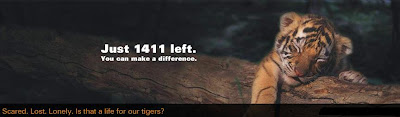
Note: The all-India 2010 census on the tiger population is being conducted by the Wildlife Institute of India (WII) and the National Tiger Conservation Authority (NTCA) as a joint effort. There had been allegations that the states had fudged tiger counts in the past, which is said to be varying somewhere between 1,165 and 1,657. This is why the present campaign to save the tigers opted for settling for an average figure which is 1,411 tigers.
Rajesh Gopal, the head of NTCA said, "for the first time, we will be using the double sampling method which will be a combination of using camera trapping of the big cat. We will also be using GIS maps to help factor in the habitat and the status of the forests."
Labels:
Endangered Species,
Save our Tigers,
Tigers,
Wild Life
Sunday, February 21, 2010
Save our Tigers
This post is made to support the petition, "save our tigers". Now the time has come for all hunters and animal lovers to come together for a common cause to save our tigers. Just 1411 tigers are left in India and as fewer as 350 are counting their days in the Mekong River region of Asia! The tiger population all over the world has slashed down at a shockingly alarming rate.
Nearly a century ago there were some 40,000 tigers that ruled the Indian subcontinent, said WWF. Poaching, wanton destruction of the natural habitat of the tigers and hunting of their natural prey are some of the major causes of the dire situation that threatens the existence of tigers across the globe today. But who doesn't know these things? What's the point of simply blogging and spreading awareness. I am sure such awareness programs will never work. Why? Because, everyone - every educated person across the world is quite aware of this threatening situation. We all know what is happening. We all know why tiger population has shrunk down so fast all over the world. I'm sure whoever is reading this post knows everything. So no point shouting about "Save our Tigers" across the web. Its a game that governments can only come up with an end. Here are just a few questions that I would like to be answered...
If just shouting and blogging for the prevention of tigers would have been worthy enough, their wouldn't have questions for law, security and punishments! I would love to blog on Save Our Tigers all year round if it could be a real solution. Years are passing by without any remarkable changes in the conditions that are causing the tiger population shrink down at high pace.
Why despite of such awareness programs tigers and many other species are getting extinct?
This is not something that general mass can solve simply by spreading awareness on something that people are already aware of. Governments have to be more proactive and must change the way they have been looking to it. Laws and securities must be stronger and should not be just to know, but to implement too! Punishment.... if they can kill tigers, they MUST be killed too.
Nearly a century ago there were some 40,000 tigers that ruled the Indian subcontinent, said WWF. Poaching, wanton destruction of the natural habitat of the tigers and hunting of their natural prey are some of the major causes of the dire situation that threatens the existence of tigers across the globe today. But who doesn't know these things? What's the point of simply blogging and spreading awareness. I am sure such awareness programs will never work. Why? Because, everyone - every educated person across the world is quite aware of this threatening situation. We all know what is happening. We all know why tiger population has shrunk down so fast all over the world. I'm sure whoever is reading this post knows everything. So no point shouting about "Save our Tigers" across the web. Its a game that governments can only come up with an end. Here are just a few questions that I would like to be answered...
- How many tiger traders were caught in the past 10 years?
- How many tiger hunters have been hung to death in the past 10 years?
- How many tree traders have been put behind the bar in the past 10 years?
- If they can kill tigers, why cannot the security force kill them?
- What steps have been taken against the paralyzed security system?
- Why is it that in just 10 decades the tiger population in India has come down from 40,000 to 1411 despite spending so much time and money on of spreading awareness?
- Why is it that even after knowing everything tigers in China are in the verge of extinction?
Why despite of such awareness programs tigers and many other species are getting extinct?
This is not something that general mass can solve simply by spreading awareness on something that people are already aware of. Governments have to be more proactive and must change the way they have been looking to it. Laws and securities must be stronger and should not be just to know, but to implement too! Punishment.... if they can kill tigers, they MUST be killed too.
Labels:
Endangered Species,
Save our Tigers,
Tigers,
Wild Life
Saturday, February 20, 2010
Tiger Year 2010 : Save the Tigers
Save Our Tigers
If you are an animal lover, you are on the right blog that talks about animals, prevention of cruelty to animals and any kind of information about animals. With the fall of 2010, the tiger year, the news about their existence has been so bad that it brought in wrinkles between our eyebrows!
There had been as many as 8 distinctive subspecies of tigers that could be found across the globe. Unfortunately three of them have already become extinct, and amongst the rest one is certain to become so within a short spell of time. Their range of existence used to be several pocket on the planet including Siberia, Russia, Iran, Afghanistan, China, India and southeast Asia, including the Indonesian islands. Sadly today, their population is severely on the wane, and just 1411 is left.
Better late than never. We still have time to spare thoughts over this. We can still do something to prevent tigers from going to museum and in the pages of history. If dogs can do, why can't we??? But my question is "what?" What can we really do? How? Will just spreading awareness work?
Stay tuned... I will share my serious thoughts.
Saturday, February 6, 2010
Big cat's trade slashes down the tiger count in Asia
Hey folks... I have been into hibernation since long. Time has turned out to be really crucial for me and life got too busy! Work hard on creating a couple of dog websites -- one on German Shepherd Dogs (my dream breed) and the other on general info about dogs. Both these websites are going to be the richest online resources of their kind across the web. So, friends, I hope you can understand very well, how deeply involved I am into my projects.Today I'm here to just run a report that popped up in my mail box this morning. Yes... a report on the tiger population in Asia! Just a meager number of wild tigers can be found in Asia. The wanton deforestation and tiger trade has turned out to be a menace to the existence of the majestic animal - the tigers. As fewer as only 350 tigers are remaining in the Mekong River region of Asia. This is what the new report from the conservation nonprofit WWF states. This tremendous loss in the number of tigers in this region has been driven by killing and illegal trading of these animals and their parts like bones, skins etc.
The tiger population in Southeast Asia has dropped by over 70% in just over a decade... claims the report run by the WWF. According to WWF there was an estimation of around 1200 tigers in that Greater Mekong region during the last “Year of the Tiger”, 1998. The Greater Mekong stretches a vast area including China, Cambodia, Laos, Myanmar, Thailand and Vietnam. So what are the governments doing to prevent the stiff fall in the tiger population from 1200 to 350 in that region? What is it that wipes out the existence of this majestic animal in some of the conservation projects that had been set up with an aim to protect them? Why is it that the enforcement of law against illegal poaching has had a limited success? What can be done to increase the awareness to stop tiger trading?
2010 is the Year of the Tiger, according to the Chinese Zodiac. Later this month, ministers from 13 tiger range countries are going to get together in Thailand for a to hold up a conference on tiger conservation.Let us hope for the best. The governments should agree on future requirement to resist the extinction of these big cats.
Friday, October 2, 2009
Genetically Engineered Animals – Animal Cloning
Before I talk about the why usually animal cloning creates abnormalities, let me brief an idea f what cloning actually is. There are different types cloning, viz. Molecular Cloning (DNA cloning or gene cloning), Therapeutic Cloning and Reproductive Cloning
Animal cloning is the highly technical process by which bio-technologists produces an organism from a single cell taken from a parent organism. The new born is genetically identical, which means the cloned animal is an exact duplicate of the parent in every respect… even with exact DNA. Dolly the first cloned mammal had been created by Reproductive Cloning. Scientists have cloned many animals. It was in the year 1952 that the scientists had cloned the world’s first animal – a tadpole. Since then hundreds of animals have been cloned, and many had been done successfully, while others proved to be unsuccessful. Cloning technologies have to be improved before more species can be successfully cloned. Many people have raised their voices against cloning as they think animal cloning as against nature, although most scientists consider that animal cloning is a major break though as this has a number of benefits in it! The most prominent beneficial possibility of a successful animal cloning is to save the endangered species from getting extinct.
Against all odds, scientists have been burning their midnight oil in making the cloning techniques better and finding why most animal cloning has created abnormalities. Dr. Takumi Takeuchi worked with the pool of medical professionals and had compared imprinting abnormalities in the embryos of mice that had been derived from assisted reproduction cloning techniques. Dr. Takumi Takeuchi, from Cornell University, New York, USA told that he and the medical team of Dr. Gianpiero Palermo had worked on this project. The doctor said, “We found significantly impaired development in the cloned embryos compared with those derived from more conventional ART techniques, and this has made us more convinced that reproductive cloning is unsafe and should not be applied to humans.”
A lot of researches have been undertaken and it was found that reproductive cloning has increased the incidence of imprinting abnormalities in genetically engineered animals. The most prominent abnormalities that have been recorded is “Beckwith-Wiedemann Syndrome”, where offspring are born larger than normal. This condition is also called “large offspring syndrome”.
The pool of medical professionals working under Dr. Takeuchi concluded that it was not fully proved if there was any direct link between the a specific cause for the abnormalities and cloning, “But there are a number of possibilities”, he said.
Thursday, August 27, 2009
Prematured Death of Basking Shark
Giant Basking Shark Had Washed Ashore on 14 August, 2009
Very recently on Tuesday July 14, 2009 a male basking shark was found dead on the Long Island beach. This 26 feet, 6 inches long majestic creature was incredibly heavy with around 5000 pounds body weight. The marine educator Tracy Marcus of the Cornell Cooperative Extension informed that the male basking shark died shortly after the had authorities arrived on the scene. According to Tracy Marcus, there wasn't any abrasion found in the external part of the shark's body. What could be the possible reason of the premature death of the basking shark? Marcus said that the shark might be struck by a heavy vessel or boat, but that was merely an assumption. The reason of the sudden death of the shark is still not known. Confusion also surged in to people's mind as to what actually made the shark find its way to the Gilgo State Park near Babylon in Suffolk County. According to David Chapman of Stony Brook University, "It didn't die of old age, because they get to 35 or 40 feet." The shark was around 26 feet long, which indicates that the death is premature. Yet still, it was an imposing site to those who were present on the beach when the shark actually washed up the shore.
The British conservationists have petitioned to have the majestic creature "hotspots" protected. Researchers have spared adequate thoughts over the issue. They think that the summer temperature might be responsible for an explosion the population of the zooplankton off the coasts of Britain and Ireland. This made many basking sharks attracted to the specific region. While during the last year (2008) there were only 26 basking sharks sighted, but the since the beginning of June, 2009 the total sightings have been recorded to be more than 900; June's record alone have shown an incredible number of sightings of 248 basking sharks!
A Marine and Coastal Access Bill has made its way through British Parliament with a noble motive to introduce "marine conservation zones". The "marine conservation zones" is a protected area in the ocean to be identified basking shark "hotspots".There will be speed limitations for the boats in this area. 47 wildlife trusts across the UK, Alderney, and the Isle of Man are heading the project. Lissa Goodwin the marine policy officer of these trusts said that the chief aim of the group "is to ensure there is no loss in the population size" of basking sharks.
Very recently on Tuesday July 14, 2009 a male basking shark was found dead on the Long Island beach. This 26 feet, 6 inches long majestic creature was incredibly heavy with around 5000 pounds body weight. The marine educator Tracy Marcus of the Cornell Cooperative Extension informed that the male basking shark died shortly after the had authorities arrived on the scene. According to Tracy Marcus, there wasn't any abrasion found in the external part of the shark's body. What could be the possible reason of the premature death of the basking shark? Marcus said that the shark might be struck by a heavy vessel or boat, but that was merely an assumption. The reason of the sudden death of the shark is still not known. Confusion also surged in to people's mind as to what actually made the shark find its way to the Gilgo State Park near Babylon in Suffolk County. According to David Chapman of Stony Brook University, "It didn't die of old age, because they get to 35 or 40 feet." The shark was around 26 feet long, which indicates that the death is premature. Yet still, it was an imposing site to those who were present on the beach when the shark actually washed up the shore.
The British conservationists have petitioned to have the majestic creature "hotspots" protected. Researchers have spared adequate thoughts over the issue. They think that the summer temperature might be responsible for an explosion the population of the zooplankton off the coasts of Britain and Ireland. This made many basking sharks attracted to the specific region. While during the last year (2008) there were only 26 basking sharks sighted, but the since the beginning of June, 2009 the total sightings have been recorded to be more than 900; June's record alone have shown an incredible number of sightings of 248 basking sharks!
A Marine and Coastal Access Bill has made its way through British Parliament with a noble motive to introduce "marine conservation zones". The "marine conservation zones" is a protected area in the ocean to be identified basking shark "hotspots".There will be speed limitations for the boats in this area. 47 wildlife trusts across the UK, Alderney, and the Isle of Man are heading the project. Lissa Goodwin the marine policy officer of these trusts said that the chief aim of the group "is to ensure there is no loss in the population size" of basking sharks.
Tuesday, August 25, 2009
Critically Endangered Gorilla Rescued
Critically Endangered Gorilla Rescued and Illegal Gorilla Trading Caught
Danger of extinction has hit every single species on the planet! The conservationists have done a great job by releasing a pack of 6 orphaned gorillas (three males and three females) in Gabon on an isolated African island called Lagoon island near Loango National Park. These gorillas have been declared to be critically endangered species and the conservationists are planning to move the gorillas into wider wild zone within three years so that can regain their population.
This is a part of reintroduction program carried out by the non-profit organization Fernan-Vaz Gorilla Project that re-habilitates orphaned Western Lowland gorillas. These gorillas have been rescued from the illegal trade they are all juveniles ranging between 2 to 7 years of age. Dr. Nick Bachand the vet had anesthetized the gorillas for the boat ride and later before they were released on the Lagoon Island, they had thorough health check up. The next morning was the delightful day for them. The drug action had worn off and they were seen exploring the Island happily!
According to the researchers, habitat destruction and illegal trading have been decreasing the Western lowland gorilla population and current they are threatened by extinction. Ebola virus is another big menace to their existence. These gorilla babies had undergone extensive forest rehabilitation and have been closely monitored.
Check out the video clip
Fernan-Vaz Gorilla Project;
Videography: Fleur van der Minne
Danger of extinction has hit every single species on the planet! The conservationists have done a great job by releasing a pack of 6 orphaned gorillas (three males and three females) in Gabon on an isolated African island called Lagoon island near Loango National Park. These gorillas have been declared to be critically endangered species and the conservationists are planning to move the gorillas into wider wild zone within three years so that can regain their population.
This is a part of reintroduction program carried out by the non-profit organization Fernan-Vaz Gorilla Project that re-habilitates orphaned Western Lowland gorillas. These gorillas have been rescued from the illegal trade they are all juveniles ranging between 2 to 7 years of age. Dr. Nick Bachand the vet had anesthetized the gorillas for the boat ride and later before they were released on the Lagoon Island, they had thorough health check up. The next morning was the delightful day for them. The drug action had worn off and they were seen exploring the Island happily!
According to the researchers, habitat destruction and illegal trading have been decreasing the Western lowland gorilla population and current they are threatened by extinction. Ebola virus is another big menace to their existence. These gorilla babies had undergone extensive forest rehabilitation and have been closely monitored.
Check out the video clip
Fernan-Vaz Gorilla Project;
Videography: Fleur van der Minne
Tuesday, July 14, 2009
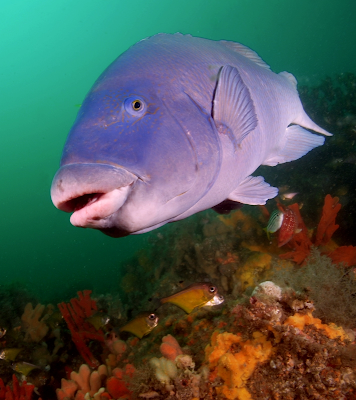
Blue Groper - The Mysterious Fish That Can Change its Sex
Professional divers in Australia have always loved watching Blue Gropers, an amazing fish that is known for it’s ability to change its sex. Interestingly this natural ability has been seldom found in the animal kingdom on the Earth. Blue Gropers that grow around three feet long and has the natural ability to get transgendered by themselves has been reported to be facing the threat of extinction. This piece is all about the the fish mystery and this mysterious fish that can change its sex.
The Blue Groper, commonly called Bluey is one of the ocean-living icons of Australian state of New South Wales. Not only their mysterious, natural ability of changing their own sex, but also their friendly nature have made these fishes one of the faves of Australian divers. SOUNDBITE (English), Bob Harcourt, Associate Professor Macquarie University said, "the blue groper is a large fish, but the really sexy thing about Blue Groper is they start off as females. We've got lots of blue groper that are small green groper and as an old male dies then the largest most dominant females turns blue and becomes male. And so one of the really cool things about these fish, is the sex ratio doesn't really vary, but it is a function of how well protected they are. If you take a lot of males out, then the females have to spend a lot of their time turning into males, which means they can't breed and they can't lay eggs." SOUNDBITE (English), Kate Lee, Researcher said, "how much time they spend in the different zones. Obviously we've come along and put down these are boundaries and put it on as a human boundary but animals don't listen to the boundaries we put. So we are looking at how much movement there is between the fished zones and the un-fished zones and if there spending a lot of time moving between the two, then obviously the reserve is going to be less effective than if they were staying in those particular zones."
Very little is actually known about the sex changing factor(s) in these fishes. What the researchers have been able to discover is that after reaching a certain age and size the female Blueys automatically get transgendered.
Interesting Facts About Mysterious Fish – Blue Groper
- Quite interestingly, although they are called Blue Groper, this mysterious fish is anot actually a Groper. Blueys actually falls in the Wrasses family.
- Blue Gropers are usually found on exposed reefs at around 0 – 40 meters depth of water. These mysterious fishes actually range between Wilsons Promontory in Victoria up the east coast to the Hervey Bay Queensland.
- Blue Groper starts off with small green color as juvenile and grows into broen or reddish. But as soon as an old male dies out, the largest and the dominant females gradually turns into blue and mysteriously becomes a big male fish.
- No Blue Gropper starts its life as a male… they always starts their life as females.
- Researchers believe that if the female population of Blueys gets increased, a female gets transgendered in to males if the male to female ratio is exceeded.
- Bluey males are quite aggressive to each other and usually one male is notice in a small school of Blue Groper females.
- Blue Groper has been reported to have an incredibly long life span of 35 years. A 10 year old Bluey can grow approximately 48cm long and can weigh around 2.4 kgs. On reaching 20 years of age a Blue Groper becomes approximately 62cm long and can weigh around 5.3 kgs and on reaching 30 years of age the Blue Gropers becomes approximately 73cm long and weighs around 8.4 kgs.
- In the year 1998, the Eastern blue groper was officially made the state fish emblem of New South Wales.
Monday, June 29, 2009
Endangered Sage Grouse - Decision Delayed
As any as three petitions have been sent to the U.S. Fish and Wildlife service with request to list the Sage Grouse as an endangered and threatened species. The Service found that the petitions had provide with adequate information about the rare bird that could warrant this rare species of bird to be listed. Fortunately the U.S. Fish and Wildlife service will be starting off a status review of the species. This is going to be the first step in the process of determining if Sage Grouse should be protected under the Endangered Species Act. Michael Bean, who is a senior adviser to Assistant Secretary of Interior Tom Strickland, said: "The Fish and Wildlife Service is well aware of the significance of this decision, because of its potential impact on a broad area and many activities within that broad area". On the other level the federal officials are still not active enough. They tend to delay a decision on whether to enlist the rare Sage Grouse in 11 Western states as an endangered species until 2010. Good news is that, the volunteers have already kick started a conservation project in the city with a donation of over $11 million in order to preserve 17,000 acres of land with a motive to enhance the typical habitat of this endangered bird. Thankfully the government has also stepped forward and stretched out the helping hands. The government has invested a huge volume of money for aerial seeding to feed the birds.
A bit about the behavior of rare Sage Grouse
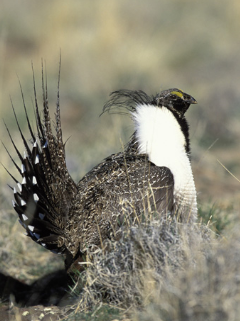
Although Sage Grouse has many common characteristic with many birds, still they show typical behavior that set this endangered species of bird apart from most other birds. Worth mentioning is that the Sage Grouse is noted for it elaborate courtship rituals. Spring is the time when the male of the species tend to show of stunning beauty a typical strut gait. Each spring (between February and April) the male Sage Grouse would puff up a white large ball on his chest. With his tail beautifully displayed and puffing up his entire body the males would strut around, by making soft drumming sound. He does this in order to attract females. Females build up their nests for laying eggs. They incubate their eggs under the cover of sage brush. Unlike most birds the nest of Sage Grouse are shallow depressions on the ground, essentially covered.
Interestingly the females lay on clutch (comprising 5 to 12 eggs in each clutch), but have been noticed to have replaced it if the eggs are lost. Females are ready to lay eggs 7 days after mating and tend to lay an egg a day. Most interesting fact about the Sage Grouse chicks is that they can walk and even fly short distances immediately after being hatched.
The Chicken-sized Sage Grouse ranges from Montana to Nevada and from California to Colorado. Activities like gas and oil drilling, livestock grazing, building wind power turbines etc are responsible for the decline in the population of these beautiful fowl. Today the exact figure f its population is not exactly known. The chicken-sized grouse ranges from Montana to Nevada and California to Colorado, living alongside livestock grazing, oil and gas drilling and an increasing number of wind power turbines. Its population has been in decline for decades, but how many remain is unknown. According to David Hensley, counsel to Idaho Gov. C.L. "Butch" Otter, the delay in the decision offers a chance to see if the measures are really effective. Hensley said: "We're trying to make the best case we can to the federal government that the species doesn't warrant federal protection in Idaho".
Saturday, May 30, 2009
Louisiana Pine Snake - Rare, Weird Snake of Louisiana
I was just scrambling around the web, looking for some amazing facts about animals. I chanced to stumble upon something that can raise a few eye brows. A bit too weird, rare and imperiled, this snake had been discovered in Luisiana. Yes, the Louisiana pine snake (Pituophis ruthveni) in amongst the rarest snakes in America, though they are found in mass in the well managed 12,000-hectare timberland in Bienville Parish, Louisiana. Now the question is how did such an endangered species could manage to thrive well amidst the wood for long? This shows a hope of light at the end of the trench and scientists tend to make more researches for managing the forest more effectively so as to preserve such endangered species!
This really sounds cool! The Louisiana pine snake had been one of the most amazing reptiles in some parts of eastern Texas and Louisiana. Old-timers in these parts of the country recalled incidences of meeting with a 1.5- to 1.8-meter long colorful reptile that they used to call "Bull Snake". According to them the snake use to draw itself straight up off the ground when approached the snake often draws itself up off the ground when approached, menacing with severe hiss and warranting painful bites - though non-poisonous. Long after the snake was last seen, that it was viewed again during the fag end of 2004. From much of its original range this amazing reptile had disappeared to a great extent. Steve Reichling, a biologist and curator at Memphis Zoo, Tennessee, said that it had been a contender for the title of most endangered snake in the US. He also said, "This is a five- or six-foot snake that's diurnal (active in daylight hours) and should be relatively easy to find. Yet it's known by only about 250 documented scientific specimens since it was described in 1929."
This rare snake is seen only in the six isolated islands that are mostly in Louisiana, although some of them are in Texas. However, the largest habitat of this endangered snake is by far the Bienville Parish timber property, which is managed by
the International Paper company. According to Reichling, ten snakes have been caught in the wild since April 1st 2006 so far. He added, "That's an amazing abundance for this species."
One most significant point that the researchers and herpetologists noted was that much of scarcity of the Louisiana pine snake has been attributed to the loss of its natural habitat - the sandy-soil and longleaf-pine-forest. According to them the wanton logging, agricultural and real estate development are solely responsible for eliminating of the ecosystem from that region. Long span of fire-suppression activities have also contributed greatly in diminishing the natural habitat of this endangered variety of snake. The old-timers said that they used to find these weird snakes during '30s and '40s, but haven't seen them crawling around in the wild in last three decades. Reichling said "The younger people have no clue that there's such a weird snake in their midst. I try to tell them, 'You're sitting on a snake that's only found here.' It has been lost to their memory in just a couple generations."
After a great deal of research for a long span of time, Steve Reichling came up with a stud book for the Pine Snake in the year 1992. He talked about the the natural history and wrote reviews on the present condition of this amazing creature.
Appearance, Nature and Behavior
Not much is known about this rare snake. The Louisiana pine snake is amongst the most impressive specimens of serpents, with buff to yellowish background. Dark brown markings near head and brown to russet markings near the tail tend to add to the beauty of the snake. Although insofar the size goes they are almost the same as the other Pine Snakes, but according to many herpetologists that are far more gorgeous than other Pine Snakes. The Louisiana pine snakes have attractive blotches that are usually some shade brown or reddish-brown. These large serpent are really magnificent and feed on rodents in the wild. Cool if not threatened, these rare snake become aggressive if approached. They tend to behave quite wildly with menacingly hissing sound raising itself off the ground straight way!
The rare pine snake has already been enlisted as the most threatened species in Texas. It has been marked as one of the most endangered species that has come into the conservation concern in Louisiana. Collaborating with other scientists, Rudolph researched out certain other factors that has contributed a lot in the decline of the Louisiana pine snake population. With the largest eggs of any U.S. snake, a Louisiana pine snake produces only 3 to 5 eggs per clutch at the most. This low reproductive rate of the Louisiana pine snake means that the species may not recover as quickly as it should.

This really sounds cool! The Louisiana pine snake had been one of the most amazing reptiles in some parts of eastern Texas and Louisiana. Old-timers in these parts of the country recalled incidences of meeting with a 1.5- to 1.8-meter long colorful reptile that they used to call "Bull Snake". According to them the snake use to draw itself straight up off the ground when approached the snake often draws itself up off the ground when approached, menacing with severe hiss and warranting painful bites - though non-poisonous. Long after the snake was last seen, that it was viewed again during the fag end of 2004. From much of its original range this amazing reptile had disappeared to a great extent. Steve Reichling, a biologist and curator at Memphis Zoo, Tennessee, said that it had been a contender for the title of most endangered snake in the US. He also said, "This is a five- or six-foot snake that's diurnal (active in daylight hours) and should be relatively easy to find. Yet it's known by only about 250 documented scientific specimens since it was described in 1929."
This rare snake is seen only in the six isolated islands that are mostly in Louisiana, although some of them are in Texas. However, the largest habitat of this endangered snake is by far the Bienville Parish timber property, which is managed by
the International Paper company. According to Reichling, ten snakes have been caught in the wild since April 1st 2006 so far. He added, "That's an amazing abundance for this species."
One most significant point that the researchers and herpetologists noted was that much of scarcity of the Louisiana pine snake has been attributed to the loss of its natural habitat - the sandy-soil and longleaf-pine-forest. According to them the wanton logging, agricultural and real estate development are solely responsible for eliminating of the ecosystem from that region. Long span of fire-suppression activities have also contributed greatly in diminishing the natural habitat of this endangered variety of snake. The old-timers said that they used to find these weird snakes during '30s and '40s, but haven't seen them crawling around in the wild in last three decades. Reichling said "The younger people have no clue that there's such a weird snake in their midst. I try to tell them, 'You're sitting on a snake that's only found here.' It has been lost to their memory in just a couple generations."
After a great deal of research for a long span of time, Steve Reichling came up with a stud book for the Pine Snake in the year 1992. He talked about the the natural history and wrote reviews on the present condition of this amazing creature.
Appearance, Nature and Behavior
Not much is known about this rare snake. The Louisiana pine snake is amongst the most impressive specimens of serpents, with buff to yellowish background. Dark brown markings near head and brown to russet markings near the tail tend to add to the beauty of the snake. Although insofar the size goes they are almost the same as the other Pine Snakes, but according to many herpetologists that are far more gorgeous than other Pine Snakes. The Louisiana pine snakes have attractive blotches that are usually some shade brown or reddish-brown. These large serpent are really magnificent and feed on rodents in the wild. Cool if not threatened, these rare snake become aggressive if approached. They tend to behave quite wildly with menacingly hissing sound raising itself off the ground straight way!
The rare pine snake has already been enlisted as the most threatened species in Texas. It has been marked as one of the most endangered species that has come into the conservation concern in Louisiana. Collaborating with other scientists, Rudolph researched out certain other factors that has contributed a lot in the decline of the Louisiana pine snake population. With the largest eggs of any U.S. snake, a Louisiana pine snake produces only 3 to 5 eggs per clutch at the most. This low reproductive rate of the Louisiana pine snake means that the species may not recover as quickly as it should.
Saturday, May 9, 2009
Orang Utans, The Critically Endangered Species
It’s really hard not to fall in love of the charming spell cast by quizzical expression of a playful kid — especially when the kid is a baby orangutan!Orang Utans, the only great apes outside Africa, have been classified as Endangered (EN) on the IUCN Red List 2007, and listed on Appendix I of CITES (3). There are as fewer as even less than 30,000 orang-utans left in the wild, although the majority are spread over the three or four subspecies in Borneo and a very small population live in Sumatra. Not all but the Bornean orang-utan has been listed as endangered species by the IUCN, while Sumatran orang-utan is facing the more threatening, and has been listed as critically endangered by the IUCN. This implies tat the Sumatran orang utans is at extremely high risk of extinction in the wild withing a very short span of time. The natural home for the orang utans is the leafy green canopy of the Southeast Asian rain forests in Sumatra and Borneo. The abundance of fruits and other edible veggies make the big apes lead a happy life out there. that these apes eat. The wanton growth of the logging industry in these areas has left this habitat in grave danger, making their population shrinking down gradually.
During November 2002, the researchers from "Nature Conservancy" had discovered a new population of orang-utans in East Kalimantan, Borneo. The group number ranged between 1,000 and 2,500, showing a light of hope that the species could be conserved well. Unfortunately, withe the passage of time there was a twist witnessed in the scenario. Researches say that these solitary apes actually need huge amount of space to thrive well. The national parks that should be safe place for them are reportedly being logged unlawfully. The growing demand of palm oil (world's best selling vegetable oil) have threatened the forest areas, where they can live safely. Almost 80% od the world's Orang Utan habitat have turned out to be vulnerable to illegal logging, gold mining and conversion to permanent agriculture, throwing the species into a zone of serious threat of extinction! Another major cause for the sudden deterioration in their population was the relentless hunting. Their slow movement made them easy target for the hunters.
Their extremely long inter-birth interval is another cause of their population having a stiff fall. 1997-98 had been a real sad time for these amazing Bornean creatures. The raging forest fire of 1997 and 1998 had destroyed almost one-third of the total orang-utan population of Borneo Island.The Great Orangutan Project (GOP) is a collection of a number of Orang Utans projects that anybody - even you and me can get involved in. The Great Orangutan Project (GOP) has been designed to save the orangutans from being extinct. You can volunteer your extra hours in this noble motive to Save Orang Utans
Wednesday, February 11, 2009
The Extinct Animal Clone Created - Extinct Pyrenean Ibex Came to Life Again

Another exciting animal news is going to show you the light hope if you really think about animals. Just lay back on your couch and spare a bit of thoughts about how fast animal species are getting extinct day by day. This animal news - a news of endangered species called Pyrenean ibex was flashed out on February 10, 2009 at the National Geographic News panels. Researchers have cloned a bucardo - Pyrenean ibex, which happened to be a subspecies of Spanish ibex that went extinct in 2000. Yes... never before this the extinct animal clone was created - though the clone had a very short span of life! But the good news is that the scientists could successfully create the clone of the extinct species and this was that first time that an extinct animal had been resurrected by cloning. Researchers had cloned endangered animal before this, but cloning of this Pyrenean ibex sparked into a topic of most talked about discussion, because this was the first time that clone had been created for an animal that had officially died out. The journal 'Theriogenology', described how the scientists used the frozen skin of a bucardo in 2003 to clone the extinct animal.
Study co-author Jose Folch, of the Center for Agro-Nutrition Research and Technology in Aragon, Spain said: "We are not especially disappointed for the death of the cloned newborn," Folch explained in an email, because such deaths in cloning experiments are common. We will try to improve the technology in order to increase the efficiency of the cloning process." According to him his team is planning to try cloning another Pyrenean ibex this year or next.

Folch and his team made clone embryos by inserting the DNA of the bucardo into domestic goat eggs. The Bucardo's DNA was sourced from the frozen skin samples taken from the lone specimen in the year 1999. Although the clones were successfully implanted into goat-ibex hybrids, but the baby had a very short span of life! Among all the 208 embryos implanted, only seven goats became pregnant, and just one bucardo were born. The baby bucardo died of respiratory failure almost immediately after the birth. Dissection showed that the bucardo had pulmonary dysfunctions, although the other organs were normal. The researchers said that such abnormalities are not uncommon in cloning. According to the scientists the environment in which an embryo develops should closely match to mitigate the problems during pregnancy.
For about a couple of centuries, wanton hunting had thinned out the population of Pyrenean ibex. The last living bucardo ended its journey in 2000, being hit by a falling heavy branch.
Smithsonian's Wildt recognized the work to be a "highly noteworthy scientific accomplishment" Wildt said "Offspring was produced from an animal well known to have suffered a recent extinction" and the bucardo story "is fascinating, because resurrection-by-cloning was the only option".
Friday, January 30, 2009
Pere David's Deer is Now a Critically Endangered Species
This piece was flashed by the National Geographic News team on October 6, 2008. Its all about the extinction crisis that continues to affect adversely the flora and fauna of the planet, according to the new Red List of Threatened Species. the threat level is on a continuous and wanton rise and has sparked a sparked a Dow Jones-like index of endangered species, that has been skilfully designed to spot out the some threatened species before it's too late. Despite the inevitable comparisons to the U.S. economic crisis, there's still no full proved plan in sight for threatened animals, said the naturalists and experts. The Pere David's deer, which is a native to China, has been named for a French missionary and has fallen in the list species listed as "extinct in the wild" on 2008 International Union for Conservation of Nature's (IUCN's) Red List of Threatened Species. The author of the report said that amongst almost 45,000 species evaluated for the new list, 38% are almost in the verge of extinction. Unfortunately the Pere David's deer has been included in that 38%! The study showed that at least 76 mammals have already went extinct since 1500, while the good news about Pere David's deer is that the effort on the conservation and captive breeding program of this variety of deer have done a bit well in the recent year! This has raised the light of hopes for recovery of the species from being absolute extinction. Now the question is, what this Red List actually is? IUCN director general, Julia Marton-Lefèvre said that the Red List is an annual "health check of the planet". The endangered species that comprise the list has been categorized into eight groups: starting from "least concern" (which are low risk of extinction) to "critically endangered species" (which are in extremely high risk of extinction in the wild in near future). For the first time in 2008, the health assessment was done for every single known amphibian, mammal, and even birds."If you look ahead a hundred years to our grandchildren and great grandchildren, how are they going to measure whether we were successful in our conservation efforts?" Russell Mittermeier, president of Conservation International, asked a briefing at the IUCN World Conservation Congress in Barcelona.
Here's a bit about the Pere David's deer - some facts:

The original habitat is of the Pere David's deer is swampy, reed-covered marshlands of northeastern and east-central China. Unlike the other varieties of deers the Pere David's deer are very much find of water and are also good swimmers, along side a good grazer! It thrives chiefly on grass, and supplements it with water plants during summer. A fully matured Pere David's deer (reaches maturity at about 14 months) gathers weight about 150 - 200 kg (330 - 440 lb). Since the last 1000 years it seems to be in a gradual process of extinction in the wild, although captive breeding program have helped regaining the population level a bit.
April - May is the birth season, the birth rate is 2 fawns maximum at a time. The gestation period is 9 months long! Life expectancy in captivity is 23 years.
Current status as revealed by International Union for Conservation of Nature (IUCN):
- 1960's: Rare
- 1994: Endangered
- 1996: Critically Endangered; (Criteria: D1)
- 2000 - 2004: Critically Endangered (Criteria: D) (IUCN 2004)
Monday, December 29, 2008
A bit About Poisonous Dart Frogs - The Endangered Species
Human impact have been slashing down the animal population wantonly, throwing many rare animals on the verge of extinction. Not discovered until 1968, the Poison Dart Frog - one of the most toxic animals in the world, is one such amazing variety of frog that is in desperate threat of extinction. Thanks to the National Aquarium in Baltimore for the noblest effort on the breeding program of Poison Dart Frog. The National Aquarium in Baltimore that offers the home land of over 16000 different varieties of animals is the best place for animal lover tourists, since it reveals scopes for tonnes of aesthetic wildly fun experiences. The aquarium's general curator, Jack Cover says: "You're gonna see a lot of diversity and the best thing, you get to see them without the extreme heat and the mosquitoes that would normally be chewing you up if you were out in the wild". If you want to see the Poison Dart Frog, Baltimore's National Aquarium is the right spot to visit.Also called dart-poison frog, poison frog or sometimes poison arrow frog, this poisonous frogs falls in the family Dendrobatidae and are native South and Central America. The most interesting characteristics that sets the dart-poison frogs apart from the other frogs, is that these species are usually active during the day. People are usually attracted to these amazing amphibians by their highly vibrant colored bodies. The poison frogs are often called "dart frogs" or "arrow frogs", because indigenous Amerindians' used to make use of their toxic secretions (batrachotoxin, which has the potency to kill many small animals and even humans, if the poison dose is higher) for poisoning their blowdarts tips, although amongst over 175 species, only three varieties have been documented as being used for the purpose. Although defined as "one of the most toxic animals in the world", but herpetologists concluded that they aren't very dangerous living inside the aquarium. As a matter of fact the are completely non-toxic when born and raised in captivity. Certain snakes and large poisonous spiders are the natural predators of the dart frog. the tadpoles, are not protected by poison; they easily fall in prey to dragonfly larvae and snakes.
Nature and Characteristics of Dart Frog:Poison dart Frogs are usually small amphibians - sometimes even as small as 1.5 centimetres in a full grown adult length, while a few grows up to around 6 centimetres. These brightly colored poison frogs have amazing patterns of designs too - usually aposematic patterns that help them to to warn the potential predators.
They lay eggs in moist places for instance wet part of plants, leaves, in plants, and sometimes exposed roots in the wet areas. The parent frogs allow their tadpoles to wriggle onto their backs immediately after they are hatched. They then carry the piggy-backed tadpoles to water, where the larva remain until metamorphosis.
Diet:
In the captivity it's not possible to provide them their natural foods, which are meadow planktons tiny termites, small beetles, ants and other tiny insects.Frog born and raised in captivity are fed planktons, fruit flies and newborn crickets charged with certain vitamins and mineral supplements. This makes them totally non-toxic.

Distribution and Habitat:
Poison dart frogs thrives well live in the rain forests of South and Central America. These amazing amphibians are found on some of the Hawaiian islands too.
Life Span:
In natural condition the maximum life span of the Poisonous Dart Frogs are over 10 years.
Subscribe to:
Posts (Atom)